





register for newsletter
get latest company news
+86 13113657186



Direct-to-Garment (DTG) printing is a digital textile printing technology that applies ink directly onto garments using specialized inkjet printheads. Unlike screen printing, DTG does not require separate screens for different colors, making it suitable for detailed designs, full-color graphics, and short-run customized apparel.
A complete DTG workflow involves several interconnected stages, including garment preparation, pretreatment, digital printing, and heat curing. Understanding how these processes work together is essential for achieving consistent print quality and reliable production results.
Why Is a Proper dtg printing Workflow Important?
DTG printing quality depends on more than printer performance. Fabric composition, pretreatment application, ink compatibility, and curing conditions all influence the final result.
Consistent Print Quality
A standardized workflow helps maintain consistent color reproduction, image details, and ink coverage across multiple garments. Proper garment positioning and uniform pretreatment also reduce variations between prints.
White Ink Performance
When printing on dark garments, white ink is commonly used as an underbase to improve the visibility of CMYK colors. Pretreatment helps create suitable printing conditions for white ink, contributing to better opacity and color brightness.
Wash Durability
DTG inks need to penetrate and bond appropriately with the textile surface. Correct pretreatment and heat curing help improve ink fixation, allowing printed designs to withstand repeated washing when suitable materials and processing parameters are used.
Production Efficiency
A well-organized workflow reduces unnecessary manual adjustments and printing errors. Using dedicated pretreatment equipment and consistent curing procedures also makes production easier to standardize, particularly for businesses handling regular customized apparel orders.
How Does the DTG Printing Workflow Work?
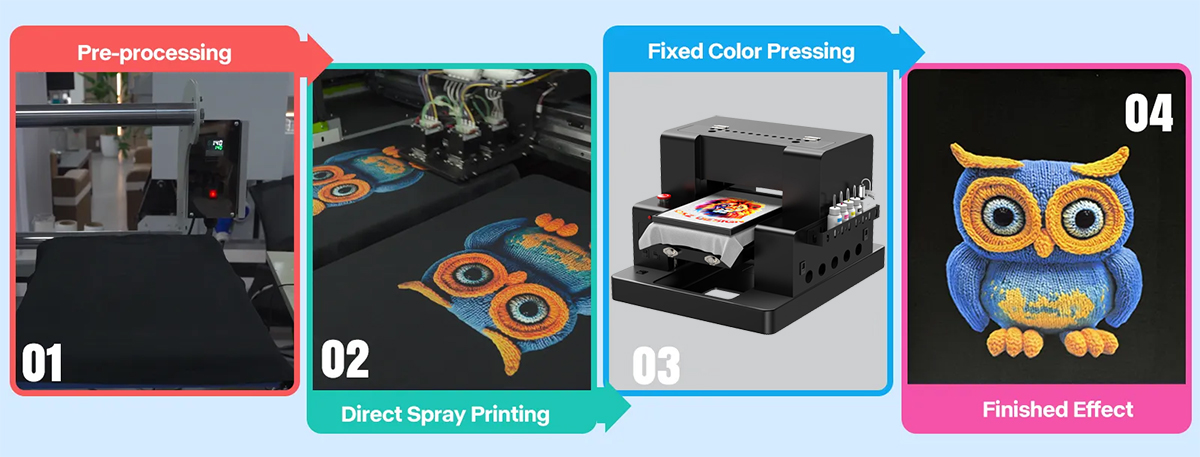
A typical DTG Printing Process follows four main stages.
1. Garment Preparation and Pretreatment
Before printing, the garment should be clean, dry, and free from dust, lint, or other contaminants. Pretreatment liquid is then applied to the designated printing area, either manually or with a spray pretreatment machine.
Pretreatment is particularly important for dark-colored garments. It helps improve white ink performance and supports the formation of a more uniform printing surface. After application, the garment is dried or heat-pressed according to the pretreatment manufacturer's instructions.
2. Digital Garment Printing
Once prepared, the garment is placed flat on the dtg printer platen. The digital artwork is processed through RIP software, which manages color separation, white ink generation, resolution, and ink output.
The printer then applies CMYK inks and, when required, white ink directly onto the fabric. This allows detailed photographs, gradients, logos, illustrations, and multi-color designs to be reproduced without traditional screen preparation.
3. Heat Curing
After printing, the garment must undergo heat curing to fix the ink onto the textile. Depending on the ink system and equipment configuration, curing can be completed using a heat press or a suitable conveyor dryer.
Temperature, processing time, and pressure should follow the ink manufacturer's specifications. Inadequate curing may result in poor wash durability, while excessive heat can affect fabric appearance and print quality.
4. Quality Inspection and Finishing
After curing, the garment is inspected for color consistency, image clarity, ink coverage, and surface defects. Wash testing can also be performed to evaluate print durability before products are packaged or delivered.
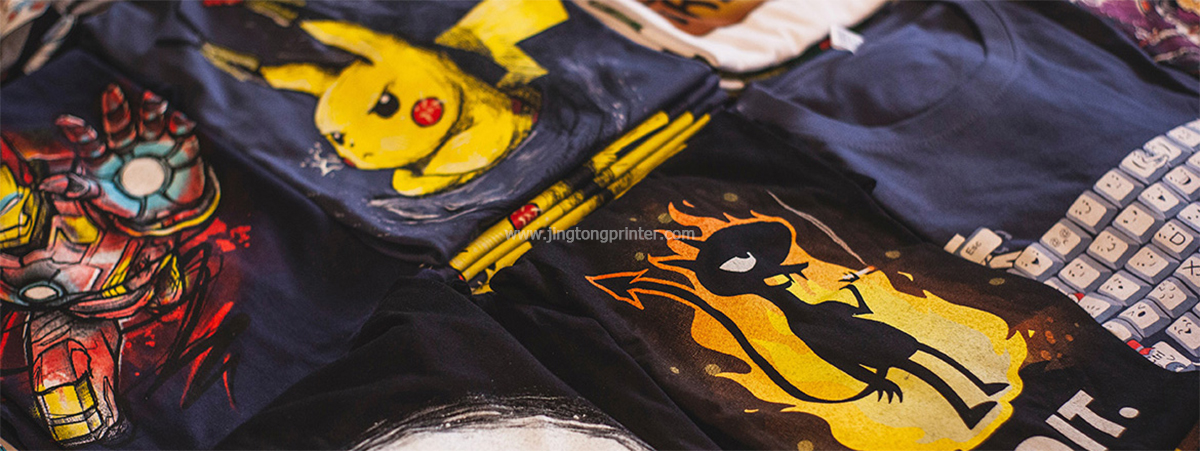
This workflow is commonly used for customized T-shirts, hoodies, sweatshirts, promotional clothing, and personalized fashion apparel.
What Equipment and Materials Are Needed for DTG Printing?
A complete DTG production setup requires compatible printing equipment, pretreatment systems, inks, and curing equipment.
DTG Printer
The DTG printer is the central component of the workflow. It uses inkjet technology to deposit textile ink directly onto garments, reproducing detailed designs without printing screens.
Common applications include cotton T-shirts, hoodies, promotional apparel, and customized clothing. Depending on the printer configuration, white ink channels allow designs to be printed on both light and dark fabrics.
Spray Pretreatment Machine
A pretreatment machine applies liquid evenly to the garment before printing. Compared with manual spraying, automated application provides better control over the treated area and liquid distribution.
This is particularly useful for dark garments, where inconsistent pretreatment can cause uneven white ink coverage, poor color appearance, or variations between prints.
DTG Inks and Pretreatment Liquid
DTG printing uses specially formulated textile inks, typically including CMYK and White Inks. CMYK inks reproduce the colors in digital artwork, while white ink provides an underbase for printing on dark fabrics.
Pretreatment liquid works with the ink system to improve printing performance on suitable textiles. Ink and pretreatment compatibility is important, as different formulations may require different application and curing conditions.
Heat Press or Conveyor Dryer
Heat-curing equipment is necessary to fix the printed ink onto the garment. A heat press is commonly used for smaller production volumes, while a conveyor dryer can support more continuous production.
The correct curing parameters depend on the ink formulation, fabric, and equipment. Following the manufacturer's recommendations is essential for achieving reliable results.
How to Achieve Better Results in DTG Garment Printing
Successful DTG production requires control over every stage rather than relying on printer settings alone.
Choose suitable fabrics, particularly cotton and cotton-rich materials designed for DTG printing. Apply pretreatment evenly and avoid excessive liquid, which may affect the fabric surface and print appearance.
Use compatible inks and pretreatment solutions, and maintain stable printing conditions. Regular printhead maintenance, white ink circulation, and proper ink storage also help prevent common printing problems.
Finally, verify curing conditions through appropriate quality and wash tests. A consistent workflow helps reduce production variations and supports reliable results for custom T-shirts, hoodies, and other personalized apparel.
Frequently Asked Questions About DTG Printing
What is the difference between DTG printing and screen printing?
DTG printing applies digital ink directly onto garments, making it suitable for full-color designs and short production runs. Screen printing uses separate screens for different colors and is generally more economical for large quantities of designs with fewer colors.
Does DTG printing require pretreatment?
Pretreatment is especially important when printing white ink on dark garments. It helps improve white ink opacity and adhesion. For light garments, requirements depend on the ink system, fabric, and printer manufacturer's recommendations.
Can DTG printers print on polyester?
DTG printing is most commonly used on cotton and cotton-rich fabrics. Standard cotton DTG inks may not provide reliable results on untreated polyester because of differences in fiber structure and ink compatibility. Specialized inks or alternative printing processes may be needed.
How is DTG ink cured after printing?
DTG ink is generally fixed using a heat press or conveyor dryer. The required temperature and curing time depend on the ink formulation and equipment. Correct curing is essential for achieving good wash durability.
What products can be made with DTG printing?
DTG printing is widely used for customized T-shirts, hoodies, sweatshirts, tote bags, promotional clothing, and personalized apparel. It is particularly suitable for designs involving photographs, multiple colors, gradients, and detailed graphics.
get latest company news
Scan To Wechat